How Hard Are Lacrosse Balls?
Solid rubber, a little over 5 ounces and built to strict NOCSAE specs. Here's what a lacrosse ball is made of, how big and heavy it is, and why it's so hard.

No hollow core. A game ball is solid rubber from the surface to the center.
NOCSAE's hardness range for a legal game ball, at 5.0 to 5.25 oz.
If you've ever watched a lacrosse game, you've seen how fast the ball moves and how hard players rip it. That leads to a common question: how hard are lacrosse balls?
Lacrosse balls are hard because they're made of dense, solid vulcanized rubber. They're a specialized ball, and you can't play the game without them.
In this article, I'll walk you through the details: size, material, weight and why they're built the way they are.
We may receive a commission if you make a purchase through a link on this page at no cost to you. This helps us keep this site free & we appreciate your support!
History of lacrosse balls
From ancient times to today, the lacrosse ball has had quite the glow-up, with each change improving quality while keeping players safer.

To really answer "how hard are lacrosse balls?" you need to understand their size and diameter too.
Read more: Where did lacrosse originate?
Lacrosse ball size (circumference)

Under the NOCSAE standard, a lacrosse ball's circumference has to be between 7.75 and 8 inches.
That size is the same across every level of lacrosse, from youth and college to the pros.
Lacrosse ball weight

A standard lacrosse ball weighs between 5.0 and 5.25 ounces (about 142 to 149 grams). That weight is chosen to balance control and speed.
A heavier ball would be harder to throw accurately, while a lighter ball wouldn't carry its momentum through the air.
Lacrosse ball diameter and bounce

That circumference works out to a diameter of about 62.7 mm to 64.7 mm, or roughly 2.47 to 2.55 inches.
When a game ball is dropped from 72 inches (1.83 meters), it should bounce back 43 to 51 inches (1.09 to 1.30 meters). For more on that, see why lacrosse balls are so bouncy.
Lacrosse ball material
The material is key to answering "how hard are lacrosse balls?" Each ingredient plays a role.
Lacrosse balls are made from natural or synthetic rubber. That rubber is what gives the ball its bounce and durability, and both matter a lot.
Stabilizers like silica are mixed into the rubber to help the ball hold its shape and keep it from getting too soft or too hard.
Pigments give the ball its color, whether it's classic white, bright yellow or something else.
Those pigments also have to meet safety standards, since the ball is constantly in contact with players' skin and the ground.
Lacrosse ball color

One of the first things you'll notice about a lacrosse ball is its color. White is the standard in men's field lacrosse because it stands out against the grass.
Women's lacrosse often uses yellow balls, and orange is common for indoor play and practice.
You might even see blue, green or pink balls at practices and special events.
Comparing lacrosse balls to other sports balls
Every ball sport uses a ball built for the demands of that game, and lacrosse is no different. Here's how they compare.

Regulations and standards
NOCSAE sets specific standards for new lacrosse balls to keep the game safe and prevent injuries. They include:
- Surface: Smooth or slightly textured, with no seams, made of solid elastomeric material.
- Weight: 5.0 to 5.25 ounces.
- Circumference: 7.75 to 8.0 inches.
- Compression-deflection (C-D): 130 ± 20 pounds (110 to 150) at 25% compression.
- Coefficient of restitution (COR): 0.60 to 0.70.
Certified balls carry the NOCSAE seal, often alongside the SEI certification mark, so look for it on the ball or packaging.
Read more: Rules of lacrosse
Why the standards matter
Ball certification is a real safety issue. According to Guardian Sports, an in-spec lacrosse ball traveling 90 mph that hits a helmet can produce a Severity Index of over 1,000, enough to seriously injure the brain.
The risk climbs when a ball hardens beyond NOCSAE's 110 to 150 C-D range.
A ball that's hardened to 215 C-D can push the Severity Index above 1,300, and a hit like that can do serious damage, like injuring the jaw joint. Keeping balls at the right hardness is essential for player safety.
Old, hard balls aren't just annoying. They're dangerous.
I've also put together a list of the lacrosse equipment you should own before you hit the field.
Read more: Positions in lacrosse
Lacrosse balls at BattleLax
Coach's note: Every season, from upstate New York to Virginia Beach to Ontario, I find a bucket of balls in somebody's garage that are slick, gray and hard as a rock. Toss them. Old balls get greasy, bounce funny and hit harder than they should. Start the season with a fresh bucket of NOCSAE balls, and keep the soft ones for wall ball in the basement.
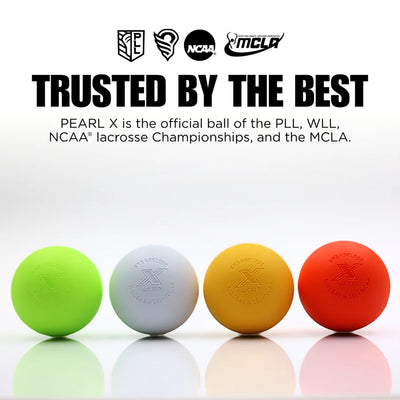 NOCSAE game ballPearl X Greaseless Balls (3-pack)$19.99 at BattleLax
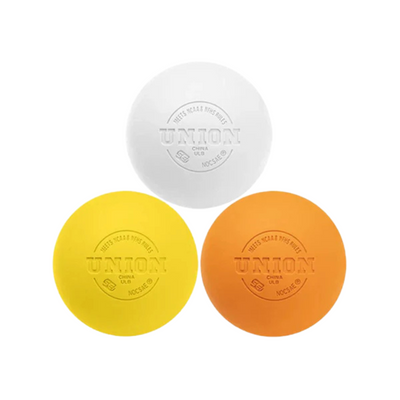 Game & practiceUnion Lacrosse BallsFrom $5.00 at BattleLax
 Softer, for indoorsUnion Soft Training Balls (6-pack)$11.99 at BattleLax
 Stick skillsHackees Mini-Balls (6-pack)$18.00 at BattleLax
People also ask
Is a lacrosse ball hard or soft?
Hard. Lacrosse balls are made from solid rubber, built to take a beating while keeping their bounce and durability. A NOCSAE game ball has to fall within a set compression range (130 ± 20 lbs at 25% compression), so it's firm by design.
How hard does a lacrosse ball hit?
Very hard. Elite shots top 100 mph, and Guardian Sports notes that a 90 mph ball hitting a helmet can produce a Severity Index of over 1,000. That's why helmets, gloves and pads matter.
Is a lacrosse ball harder than a tennis ball?
Yes, much harder. A lacrosse ball is solid rubber, while a tennis ball is a hollow, pressurized rubber core covered in felt.
Does it hurt to get hit by a lacrosse ball?
Yes. Between the hardness and the speed, a lacrosse ball can leave a serious bruise or cause injury, especially if you're not wearing protective gear.
Why are lacrosse balls made of rubber?
Rubber gives lacrosse balls durability, a consistent bounce and the right firmness to meet NOCSAE standards for performance and safety.
So, how hard are lacrosse balls? Honestly, they're pretty tough. Made from solid rubber, they're built to handle a physical game. Now that you know the specs, size, weight and material, you can see why they're made with so much precision. If you haven't held one yet, pick one up and feel how dense it is. And when you're ready to stock up, check out our guide to where to find the best lacrosse balls, or grab a fresh pack of Pearl X game balls at BattleLax.