Why Are Lacrosse Balls So Bouncy?
Solid rubber, a lot of stored energy and strict bounce specs. Here's the science behind the bounce, and how to read it on the field.

Lacrosse balls are solid vulcanized rubber or elastomer blends that squash on impact and spring right back.
A legal game ball has to bounce back 43 to 51 inches when dropped from 72 inches, keeping roughly 60 to 70% of its drop height.
After more than a decade of playing lacrosse, there's one question I hear from newcomers and weekend players alike: "Why are lacrosse balls so bouncy?"
You're running it down, reading the ball, and then it takes a hop you never saw coming. Anybody who's chased a ground ball on a hard, dry field in August knows the feeling.
Lacrosse balls are bouncy because they're made from solid vulcanized rubber or elastomeric polymers with a high coefficient of restitution. A legal game ball bounces back 43 to 51 inches when dropped from 72 inches, so it keeps roughly 60 to 70% of its drop height.

That material, combined with careful molding and heat curing, makes a ball that compresses on impact and snaps right back to its shape. That's where the big bounce comes from.
I've watched players fight those unpredictable bounces more times than I can count, whether it's a ground ball that suddenly pops up or a shot that ricochets off the crossbar in a way nobody expected.
If you don't understand what's behind the bounce, you're leaving yourself open to missed ground balls and even injuries. Once you understand the physics and design, you'll have a real edge in reading the ball. Let me break down everything you need to know.
We may receive a commission if you make a purchase through a link on this page at no cost to you. This helps us keep this site free & we appreciate your support!
The bounce evolution of lacrosse balls
Lacrosse has a rich history, and the way the ball has changed is fascinating. When Native Americans created the game, they made balls from whatever nature gave them: deerskin pouches stuffed with fur, hand-carved wooden spheres and even molded clay.

Those early balls weren't the perfect spheres we use today. They were often egg-shaped, which made the game even more unpredictable.
In the colonial period (1600s to 1800s), players got creative by wrapping leather around stone cores. The real game-changer came in the 1860s, when Montreal dentist Dr. William George Beers helped standardize the game and its equipment, including a move to rubber balls. That moment shaped the future of lacrosse.
We've come a long way since then. Modern lacrosse balls are made from solid vulcanized rubber or advanced synthetic blends, and every game ball has to meet strict NOCSAE standards for safety and performance.
Read more: How hard are lacrosse balls?
Material composition: what makes a lacrosse ball bouncy?
To understand why lacrosse balls are so bouncy, start with what they're made of.
Lacrosse balls are solid vulcanized rubber or elastomeric polymers, built for bounce and durability. That rubber is chosen because it's highly elastic. When the ball hits the ground, the rubber squashes, then its elasticity kicks in, pushing the ball back out and up into a bounce.
Solid vulcanized rubber is the star of the show.
The specific mix of materials boosts that elasticity, so the balls can take a beating without losing their shape.
The physics of bouncing
Here are the basic physics principles behind why lacrosse balls are so bouncy.
When you drop a lacrosse ball, it accelerates toward the ground at 9.81 m/s². On impact, the rubber compresses and stores energy. Because the ground is solid, a big share of the ball's kinetic energy gets stored in that compressed rubber. Once the ball stops moving down, the rubber expands and launches it back up into the air.
Spin matters too. A ball comes off the stick spinning, and on hard shots or long passes, that spin can make it bend off its line, a lot like a baseball pitch. It also changes how the ball kicks when it hits the turf or the pipe, and how far it bounces depends mostly on how fast it hits the surface.
Coefficient of restitution (COR)
COR measures how much energy a ball keeps in a collision. A lacrosse ball's rubber gives it a high COR, so it holds on to a big share of its energy after each bounce. That's why a legal ball comes back up 43 to 51 inches from a 72-inch drop. For a deeper dive, check out this breakdown of lacrosse ball physics.
Elastic potential energy
When the ball compresses on impact, it stores elastic potential energy. As it decompresses, that energy turns back into kinetic energy and pushes the ball upward. Physics students at Tualatin High School put together a good research project on how a lacrosse ball stores and releases energy.
Impact of temperature and environment
Outside factors like temperature also change how bouncy a lacrosse ball is.
Warmer temperatures make the rubber more elastic, so you get higher bounces. Cold makes the ball stiffer, so bounces stay lower. If you've played an early-March game in upstate New York and a July tournament in Virginia Beach, you've felt the difference: the same ball that dies on frozen turf in March is jumping off the hot carpet in July.
These principles help explain why lacrosse balls bounce the way they do compared to other sports balls.
Coach's note: Old balls get greasy and hard, and that changes the bounce and the grip. Rotate fresh balls into practice, and use a greaseless game ball like the Pearl X on game day so the ball you warm up with plays like the one you'll see in the game.
Manufacturing process: how lacrosse balls get their bounce
How a ball is made plays a big role in its bounce. Through molding, curing and pressure adjustments, manufacturers make a ball that's consistent in shape and highly responsive.
Molding
The rubber is molded into a solid sphere so every ball is the same size and weight.
Curing
The molded balls are heat-cured to boost their elasticity.
Testing
Each batch is tested for bounce height and consistency. By the rules, a standard lacrosse ball should bounce 43 to 51 inches when dropped from 72 inches.
Lacrosse balls vs. other sports balls
To put it in perspective, here's how a lacrosse ball's bounce compares with other common sports balls.

Regulation standards
Knowing whether a lacrosse ball should be bouncy means knowing the rules for game balls. Game balls have to meet the NOCSAE standard (National Operating Committee on Standards for Athletic Equipment), and the playing rules set these specs:
- Weight: 5.0 to 5.25 ounces
- Circumference: 7.75 to 8 inches
- Bounce height: 43 to 51 inches when dropped from 72 inches
That consistent bounce keeps the playing field level for everyone, no matter which brand of ball is in play. When you're buying game balls, look for the NOCSAE stamp on the ball.
 Game ballPearl X Greaseless Balls (3-pack)$19.99 at BattleLax
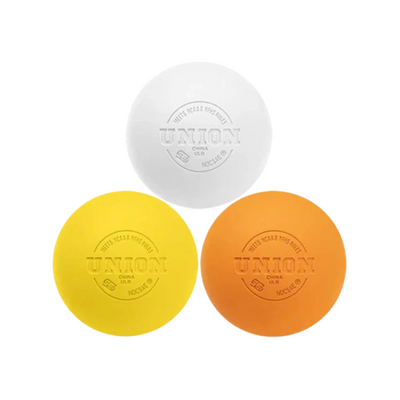 Game & practiceUnion Lacrosse BallsFrom $5.00 at BattleLax
 Indoor trainingUnion Soft Training Balls (6-pack)$11.99 at BattleLax
 Stick skillsHackees Mini-Balls (6-pack)$18.00 at BattleLax
Read more: Where to find cheap lacrosse balls
People also ask
Are lacrosse balls supposed to be bouncy?
Yes. Lacrosse balls are designed to be bouncy. Their high elasticity makes for faster passes, better rebounds and a quicker game pace, and the rules require a game ball to bounce back 43 to 51 inches when dropped from 72 inches.
Why do lacrosse balls bounce funny?
Lacrosse balls can bounce unpredictably because of spin, grip and the surface they hit. Spin off the stick can make the ball curve or kick sideways on a bounce, a lot like a curveball in baseball, and a worn, greasy or hardened ball bounces less consistently.
What makes lacrosse balls so bouncy?
Lacrosse balls are made from solid rubber, a highly elastic material. The rubber compresses on impact, stores energy, then springs back to its shape and pushes the ball back up.
What is the purpose of bouncy balls in lacrosse?
The bounce makes the game faster and more challenging, with quick rebounds, crisp passes and smooth shots.
How do temperature and environment affect lacrosse ball bounce?
Warmer weather makes the rubber more elastic, so the ball bounces higher. Cold weather makes the ball stiffer, so it bounces lower.
That's everything you need to know about why lacrosse balls are so bouncy, from the materials and manufacturing to the science behind that reliable bounce. Understand it, and you'll read hops and ground balls a step quicker than the guy next to you.